
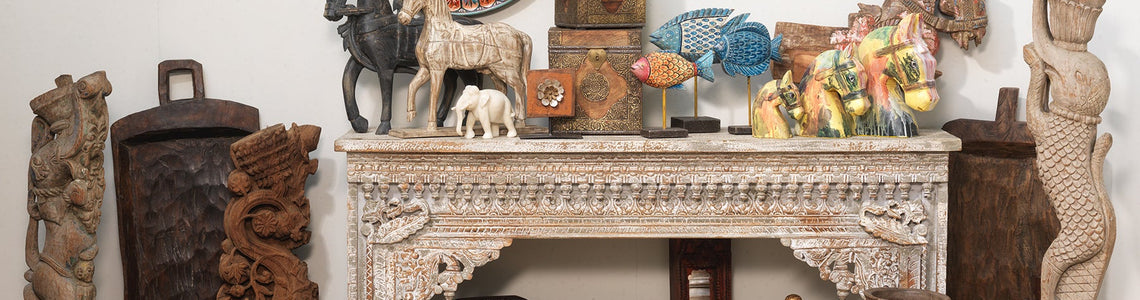
Carved Indian Furniture: Traditional Craftsmanship for the Modern Home
Carved Indian furniture has a presence that is difficult to reproduce in factory-made pieces. The difference is there in the timber, the hand-worked surfaces and the small variations that come with age and use. A carved panel may be slightly irregular. An old cabinet may carry traces of earlier paint. A sideboard can have knocks and wear accumulated over decades. These are part of the piece rather than faults to be disguised.
At Kayu Home, our Vintage Indian Furniture collection brings together furniture and decorative pieces selected for their workmanship, useful proportions and individual appearance. The range changes as pieces are sourced, with vintage furniture sitting alongside pieces made using older reclaimed timber.
Hand Carved Indian Furniture and Traditional Craftsmanship

Good hand carved Indian furniture rewards a closer look. The carving has depth and variation because it has been worked rather than stamped into a uniform surface. Traditional patterns range from geometric lattice designs to floral forms, birds and more elaborate decorative motifs.
Jali work is particularly recognisable. Originally associated with architectural screens and decorative openings, its repeated pierced patterns create strong shadow and texture. Kayu Home currently carries carved jali panels from Rajasthan, including designs with geometric lattice work and peacock motifs, as well as larger hand-carved wooden panels influenced by the architectural traditions of western India.
Used indoors today, these pieces work well as wall art or as a substantial decorative element above a console, sideboard or bed. They have enough detail to hold a wall without needing much around them.
There is similar workmanship in carved chakki tables. Traditional chakki bases were originally associated with grain grinding in rural India. Vintage teak examples from Gujarat and Rajasthan can now work as low side tables, giving an old utilitarian object a quite different place in the home. Kayu Home’s hand carved Indian furniture includes examples where the original form and carving remain very much part of the appeal.

Vintage Indian Furniture: Cabinets, Sideboards and Decorative Pieces
Carving need not dominate a room. Often it works best on practical furniture where the detail is balanced by a straightforward shape. Indian carved cabinets and sideboards are a good example. Doors, panels and frames can carry decorative work while the furniture still earns its place through storage. Kayu Home’s current collection includes solid wood sideboards from Gujarat and Rajasthan, painted cabinets, lattice-fronted side cabinets and pieces made using reclaimed or salvaged Indian timber. Some retain weathered paint and distressed surfaces; others have more detailed decorative finishes.
That variety matters. Someone looking for antique Indian furniture for a restrained interior may prefer natural timber with a quieter finish. In a room with pale walls and simple upholstery, a painted cabinet can take more of the attention. Neither approach needs a heavily themed interior. One well-chosen piece is usually enough.
Smaller vintage Indian storage boxes and chests can serve the same purpose on a more modest scale. They bring aged timber and practical storage into a room without requiring the space of a large sideboard or cupboard.
For buyers comparing Indian wooden furniture, it is worth looking beyond colour alone. Proportion, condition, timber, carving and how the piece will actually be used at home matter more over time.

Choosing Carved Wooden Furniture for a Contemporary Interior
Carved wooden furniture is surprisingly easy to place when the room around it is kept fairly settled. Contemporary interiors, older houses and country homes can all take these pieces, though scale is important.
A large carved panel needs breathing room. A substantial sideboard should have enough wall space to avoid looking squeezed between other furniture. Smaller cabinets are easier to use beside a bed, in a hallway or next to an armchair. Chakki tables suit spaces where a lower, compact surface is useful.
It also pays to accept the material for what it is. Vintage Indian furniture can have old repairs, changing colour, worn paint, uneven surfaces and marks from previous use. Reclaimed furniture carries similar variation. For many buyers, that is precisely why an older piece has more interest than a newly manufactured equivalent.
Kayu Home selects furniture with an eye to both appearance and everyday use. As many vintage pieces are individual, the collection naturally changes. If a particular carving, proportion or finish suits your room, it is sensible to consider the piece while it is available.
About Kayu Home
Kayu Home specialises in vintage Indian furniture, vintage Chinese furniture, recycled furniture and sustainable furniture chosen for craftsmanship, material quality and character. Our Indian collection ranges from carved panels and chakki tables to cabinets, sideboards and storage pieces, with reclaimed timber used across many designs. Browse Kayu Home’s current range to find furniture with genuine age, considered workmanship and a useful place in today’s home.
Vintage Indian Furniture | Indian Heritage Furniture | Gujarati Furniture | Carved Indian Furniture | Pithara Chest | Damchiya Dowry Chest


